Showing posts with label 1955. Show all posts

Monday, 7 June 2021

๐Ÿ‡ฌ๐Ÿ‡งMy Early Memories of the UK (1955-56)


We reached London in August 1955. It was probably the worst time in the year to go to the UK.

We disembarked from SS Batory in Southampton and went by train to London. We had a flat on the First Floor on 5, St Charles Square, Ladbroke Grove, London W 10 with a kitchen and a bathroom on the left as you look upwards and our bedroom/drawing room on the right facing the front. I went back to this address around 2005 and it was still there.  Better painted but still otherwise the same. In front of our window, where earlier there was nothing, now was a school.  Beside our house on the lane on the right was a bus terminus which is not there any more.


My earliest memory is of post-war London. Cold, grey, drizzling and an acrid smell in the air. I first joined Oxford Junior School but it was quite far from home and I changed over to Bevington Primary School which was closer and at the junction of Portobello Road, famous till today for its Saturday market when second hand goods and antiques were sold for a pittance.

My classrooms were bright and airy we were always in one fight or more at the same time (especially with the girls). At our 11o'clock break we would get a sealed bottle of whole milk which was compulsory but an ordeal to drink because it was so cold. Then we would go out into the playground to play or fight (usually wrestling). We would play a game called "conkers" where we would attach a thorny fruit (a conker) to a string and swing it about the adversary's conker and deftly pull the string till one conker broke away.  The conker that had parted with its string was the loser.

It was back to classes till lunch which was in a huge hall. There we would have to collect our plate which would have some bread, potatoes, vegetables (usually spinach) and some gruel with a piece of meat. Ma told me many times to enquire whether it was beef and then not eat it if it was. But I never did because there was no substitute and if it was beef then I could not eat it and would have to go hungry and attract the attention of the teachers whose main purpose in life seemed to be to ensure that the children gorge themselves right up to their throats. In any case it tasted good and the brown sauce was a treat. Sometimes it was fish and chips which was also nice. Then, at the end of the school day, it was a weary walk back home with Ma and Moon in her pushchair stroller pram. Ma would take this opportunity to do her shopping on Portobello Road. I was always fascinated by the wares that were sold and also the big Woolworth's there. Ma had a stiff leather bag shaped like a bucket which Daddy called "balti bag" into which she would stuff her purchases. Once, I remember, her purse was picked from this bag and we never got it back.

Right at the junction of our school and Portobello Road was a butcher's shop. Ma would buy lamb (no goat's meat there) and our weekly treat would be lamb curry and rice. This had a superb flavour and taste which I have never tasted since. They also sold some exquisite cold meats which Ma would buy once in a rare while as a special treat.  After all, we had to subsist on £80/- per week which was the allowance Daddy got (an absolute pittance in today's money but somewhat reasonable for us 4 then). The unsavoury part of the story was that the meat had been in cold storages for a decade or more as a wartime buffer. On the other corner was a post office which sold all kinds of stuff from newspapers to cigarettes and everything in between including small eats. Moon would often get a lollipop from this shop if she had been a good girl.

Ma soon started attending evening classes in cooking, knitting and sewing (probably what is known as fashion design in modern parlance). I remember she would come home awfully late at night while Moon and I cowered in fear as the roads were not safe at night. Daddy studied on oblivious to the world.

Then came the shattering news that the Suez Canal was closed and we could either wait till it opened or go back to India round Cape of Good Hope as Vasco da Gama had done about 450 years earlier to reach Calicut. We waited a few months and then, when the Suez War was getting more strident, Daddy took the decision to return via the Cape. So we returned to Bombay on SS Circassia boarding at Liverpool with a stop at Cape Town riddled with apartheid. Circassia was a more luxurious and faster ship than Batory, but I do not remember it being as much fun as the Batory where the Cheese Scrambled eggs were divine and it was my first sea voyage. I think we finally reached Delhi in March/April 1957 and I joined back St Columba's for half a year before starting in St Joseph's Bangalore in January 1958.

Added by Biswajit Basu based on the displayed picture:

In fact, this first one is THE very house as it looks now. It was a dark red during my time. On the lane running beside the house was a bus terminus where there were a couple of double-deckers which are not there now.  At the back we had a retractible double rope on pulleys strung to the back of the house behind to dry our clothes in those rare days of sunshine.

You would climb up the stairs to the front door.  The owner, Mr EP Young stayed in the Ground Floor and his daughter, Mary, would often answer the bell.  Once inside you walked down a short corridor (with the only phone) and turned left, to go up the stairs.  On the first floor landing, on the left was the kitchen and the bathroom and across the landing corridor was the door to a huge room which was our combined bedroom and drawing room.  The bed was huge and all 4 of us slept on it.  There was a sofa and some chairs and a lovely cosy fireplace which we only ran occasionally and lived to the heat from a paraffin heater in the centre of the room.  The huge windows that you see in the front of our house on the first floor were our bedroom/drawing room windows.  The Pathak's were on the second floor and were replaced by the Gangulys.  Their son, Monomoy Ganguli, who was not yet born then but retired recently as a Lt General as the Director General of Medical Services (DGMS).  He is presently the head of the Parsi Petit Hospital in Bombay.  Their flat, above ours, was exactly the same as ours.

I would come down the stairs, emerge out of the door and turn right to go to school.

I can draw you a sketch of our flat to give you how we lived in these cramped circumstances for 2 years.  I got appendicitis on that bed in December 1955!

Post Script:
Daddy went to study for DO (Diploma in Opthalmology)


Author note: 
More about the voyages are in these posts -

A mention of neighbours is in this post - 

Monday, 25 January 2021

๐Ÿ›ณ My First Sea Voyage


From Biswajit Basu:


MY FIRST SEA VOYAGE

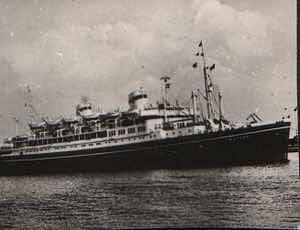
 I can still remember. It was July 1955 on a hot, sunny and humid afternoon. I was at the Ballard Pier in Bombay with my two-year old sister and my parents. My father was going to study in London; courtesy the Indian Army and we were accompanying him. I was all of six years old then. There were thousands of people milling around us – fellow-passengers, porters, ship’s crew, government officials, shipping agents etc. The sounds, smells and colour swirled around me in a kaleidoscope of sensation. The sensory overload was stifling and yet the moment seemed exhilarating. But one thing before us was overpoweringly awesome to my schoolboy eyes. Big, shimmering and a stately black in the afternoon sun was S.S. Batory, the ship that was going to be my temporary home while transporting me to a new land and a new way of life. She belonged to the Polish Ocean Lines and did Bombay to Southampton in about twenty days. She was truly an awesome sight to my childhood eyes.


(Blogger Note: MS Batory was a truly iconic ship!)

The first hours on board was a flurry of activity getting all our small bags into our cabin and our steel trunks into the baggage hold. We carried with us all our clothes, shoes and pots and pans in anticipation of a full year abroad. We then settled down to our tiny cabin below deck. When you entered our cabin, there were four bunks in two tiers to the right perpendicular to each other along the walls and a solitary desk on the left with a tiny round porthole above it framing a small piece of the blue cloudless sky. It was gloomy like a prison with steel beds, steel walls and a steel floor. The fan less cabin had an old and weary slightly mildewed smell. I fell into fitful sleep that evening.

Sometime next morning, the engines of the great ship came to life and she slipped her moorings and turned; passing Butcher Island to the left as she, seemingly silently, carried a thousand souls into the Arabian Sea heading towards Karachi in the newly formed country called Pakistan.

Very soon we were there. My father decided to take me ashore with him to visit an old friend of his who was now in the Pakistan Army. It was like two long-lost brothers meeting, though the two armies had already antagonistically faced each in battle in the distant beautiful mountains in Kashmir. My dominant memory of Karachi is sand. Yes, miles and miles of yellow sand through which we had to trudge to get to the city. We stayed a day in Karachi and were on our way again: our bows slicing the Arabian Sea as we headed towards Socotra and Aden.

Aden was a shopper’s delight. I remember that my mother wanted to buy everything in sight from a Parsee’s shop there. My father gently restrained her and to his relief, we were soon on our way again. Next stop was Port Said in Egypt on the southern side of the Suez Canal. What I remember most about this place were the flies. They were everywhere – millions of them. I wished I had a tail like the camels that stood around, that I could use to flick them away. The ship was also overrun by hawkers and they seemed to sell all kinds of knick-knacks like pens, souvenirs, watches, leather wallets, knives and suchlike wares. My father, who was familiar with North Africa from his war- years, told me that they were known as Gyppos as they could dupe anyone out of his hard-earned money. We went ashore to visit the city.

The passage through the Suez Canal was truly a memorable one. I could hardly believe that such a huge ship could wend its way through such a narrow channel. On both sides were wide expanses of sand with a solitary railway line on the African side. My young mind then could never have understood the politics that would delay our return to India because of the differences between the Egyptians and the British over the control of the Suez Canal. We finally returned to India on the fast and relatively luxurious Anchor Line Ship S.S. Circassia in 1957 – but that is another story.

The journey through the Mediterranean Sea was smooth, placid and beautiful with bright sunny cooler days and starlit skies. Then suddenly through the morning mist, I saw Gibraltar. As we sailed through that historic strait, I saw the great Atlantic Ocean for the first time. The sea was getting rough.

As we entered the Bay of Biscay, we literally sailed into really stormy weather. I began to feel queasy in my stomach and threw up everything I ate and seemingly more. My father felt that I would feel better if he took me to breathe some fresh air on deck.

For the first time in my life, I saw the fury of an angry sea. I was spellbound as I emerged into the open. Howling and blowing furiously, I tasted the sea-salt in the wind which whipped my coat as I looked up to see the unending grey sky above. The sea was rolling slowly in mountainous waves of inky-blue, streaked at their crests with wind-whipped white foam which crashed against the side of our ship struggling to ride it. Cascades of seawater flew up along our sides as each wave hit us with the sound of distant thunder and showers of diamonds flew up into the sky. I was transfixed and realised how small I was in the face of this awesome fury of nature.

All along the length of the deck they had tied a rope about a yard from the ship’s railings to prevent any passenger from going too close to the railings at the deck edge. Suddenly, the ship rolled jerkily and viciously and I felt myself toppling as I tried to grab, but missed, my father’s hand and slid along the deck towards the railings. I felt my legs go overside as I came up hard with a vertical railing stanchion between my legs. In that terrifying moment, I heard my father shout over the howling wind as I teetered on the edge. I was suspended precariously over those heaving white-flecked grey waves as Hydra-like, they rose to engulf me to a watery death. Relief was when I felt the comforting hands of my father pulling me back from the brink with the help of a crew-member. As I groggily walked back to the accommodation entrance, I was positively terrified, shaken and numb with fear. Little did I know that despite this terrifying experience, my destiny would lie in sailing these tempestuous seas, as a profession. I noticed that my father did not tell my mother about my fall. I did not either. It was as if we shared a lovely secret which we never spoke about till he died many years later. I suddenly also realised that I did not throw up any more!

The rest of the trip to Southampton was dominated by grey skies and the unending heaving and roiling of the tempestuous sea.

I do remember the meals were nice on the Batory and I had a special liking for their breakfast. The omelette they served was absolutely perfect! Another thing that fascinated me was the view through the portholes of the dining room which lay well below the main deck. On a rolling ship, one moment we would be looking up at the grey sky overhead that swung rapidly till the porthole was submerged into green waves below. The table edge stoppers would be up and I loved seeing the crockery and cutlery journeying across the tablecloth as the great ship swung wildly. An occasion of mirth would be when some unsuspecting soul fell off his chair despite it being tightly chained to the floor.

Finally we were there. I felt like kissing the rain-swept cobbled wharf which gave me a steady platform to stand on that I had not known for many days. But, at the same time, there was a foreboding sadness on that sombre day. Wrapped in a warm coat, I shivered gently on that icy, damp wharf as slowly the cold permeated to chill me to the bones. I wondered whether I trembled because of the cold or because I was terrified of my uncertain future in a new land. I tightened my hold on my father’s fingers.

It was August in England.

When would I see my bright, sunny and colourful India once again?


Context: Basu family trip India-UK-India, 1955-57


Post Script 1 by Biswajit Basu, January 2021:

We went by Polish Ocean Lines MS Batory that took us from Bombay to Karachi, Aden, Port Suez, Port Said, and finally, Southhampton (we went through the Red Sea). So, through the Arabian Sea, Red Sea, Mediterranean Sea, Bay of Biscay, English Channel.

On the return, the Suez Canal was closed so we went by SS Circassia of the Anchor Line non-stop, (if I remember right), from Liverpool to Bombay, but maybe we stopped at Cape Town to refuel, but were not allowed ashore because of apartheid. So the route was Irish Sea, North Atlantic Ocean, South Atlantic Ocean, round Cape of Good Hope, Indian Ocean, Mozambique Channel & Arabian Sea.

(To read more about the return voyage, click here.)


Post Script 2 by Biswajit Basu, January 2021:

I wrote this maybe 20-25 years ago.  But the colours and smells were so exuberant and  exciting that they still linger in my memory.

The Bay of Biscay was terrifying.  Later in my career I sailed through it many times and it was never calm.  Sometimes it could rival the storms around the Cape of Good Hope.  In fact the stupendous waves that batter the northern coast of Spain, which were like the jaws of hell for us are a tourist attraction today!

I remember the four of us in Southampton Station waiting forlornly for our train to London.  The despondency of the grey skies, the incessant drizzle and the faraway alien land is still in my heart and memory.  It was a terrible day.

*Picture Credits: MS Batory, Wikipedia


Sudeshna Dey memories

  Picture of Sudeshna Dey and her grandmother Gopa Ghose, circa unknown.  Gopa Ghose - age 30s, Darjeeling Sudeshna Dey nee Ghose - 21 years...