Monday, 24 May 2021

πŸ–‹My Life - A poem by Biswajit Basu

MY LIFE
By Biswajit Basu

Dedicated to my sister, Moon’


1
I look past the drizzle on my window at the mellowed sun

Mellowed by the decades of passing clouds of life,

And I sit today and look back at years of ups and downs,

Mostly up and rarely down, I must honestly admit.

2
But it has been a respledent, flowery and full life.

With every path therein forecharted into an indistinct passage

With slight tinges of design sometimes  thrown in. 

More in hope than any certitude of events to follow

Visible mostly in retrospect, rather during its passing

The journey has been  the life of a venerated old ship

That has toiled its life in the service of mankind

But was never spared the buffeting of vicious storms
when they came a-roaring by.

Only to sail victorious into calmer seas that always followed a rough passage


As I look back at the years that have passed,

A feeling of peace settles deep in my heart

And I know I have done in the brief flash that was my life

Playing to mankind a small but significant part.

But everything in this Universe that is born

Is destined to be consigned to flames in the end

Whether it be billions of years in the timeline of the Universe

So it is to roughly seven decades allocated to a  man

It all ends in fiery glory to a grand finale.

Friday, 21 May 2021

πŸ”„ 6 Decades, 2 Six year old girls and 1 Hula hoop

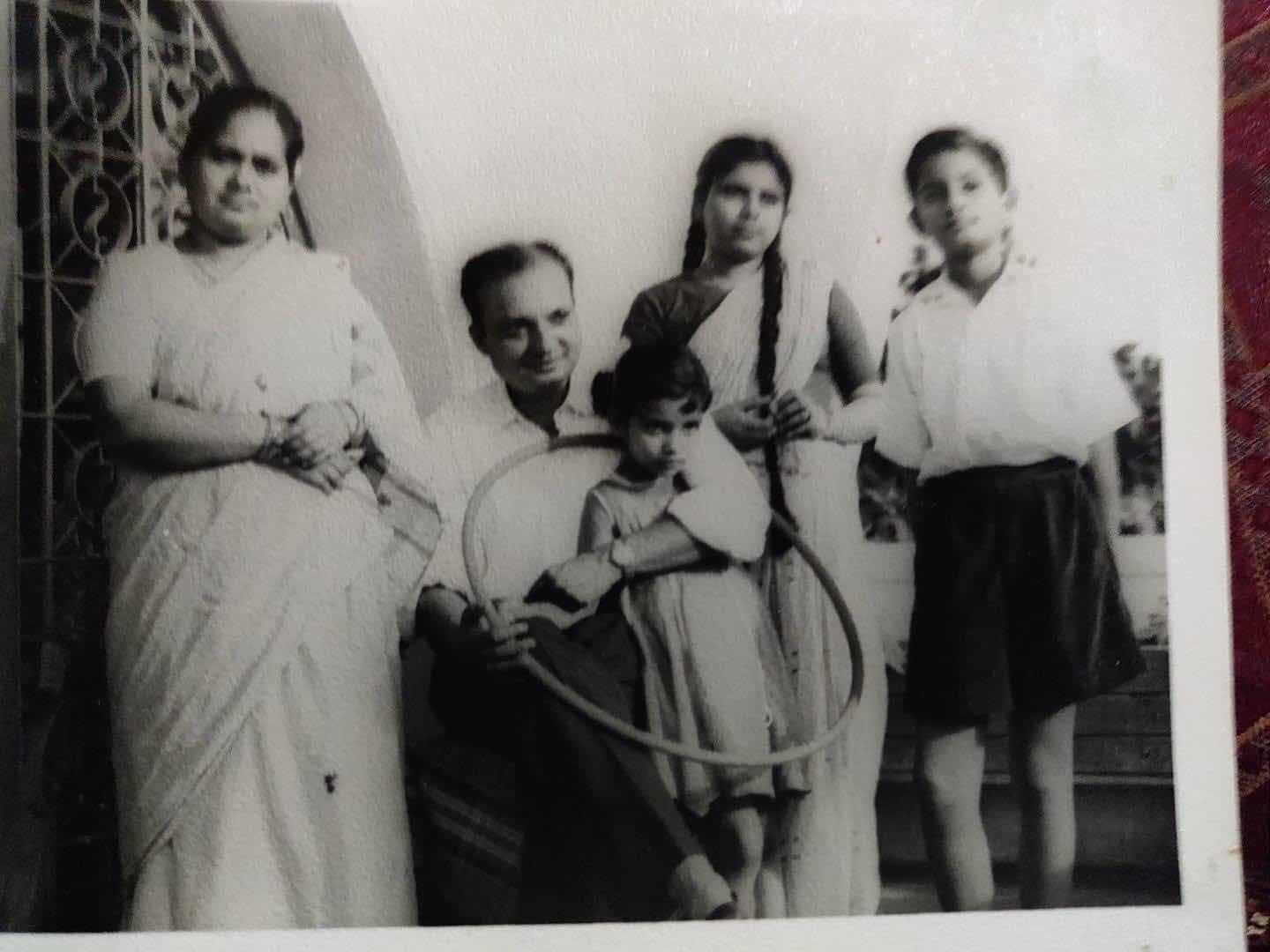
While going through Mom’s (Monisha Choudhury) old photos, I came across this little gem on her Facebook. 


(L-R: Anima Basu, MK Basu, Monisha Choudhury, Pronoti De, Biswajit Basu)

“With my parents, brother and aunt. Bangalore 1959.

This house was special and beautiful . It had a solid teak round door opening into the balcony on the first floor where we are standing in a curved corner. The grill...partly visible had a silver paint and was quite unique in design. 2/1 Broungton Cross Road just off Mahatama Gandhi road was a house in then a serene suburb. On A bread nut tree across the road where Bush babies..Loris who were spotted rarely!”

Added by Biswajit Basu, May 2021:

“Our address in Bangalore was 2/1, Brunton Cross Road. It was parallel to the Mahatma Gandhi Road and between Brunton Road and Primrose Lane at right angles. There lived an old English couple in a sprawling house in front of ours and the Manekshaws. It had breadfruit, jackfruit and silk-cotton trees. The lovely forested environs is completely built up now and our house is an ad agency office!

The English gentleman treated us as Mr Wilson treats Dennis! πŸ˜ƒ. I walked two miles to school from home.”

(There’s a little more about Brunton Cross Road neighbours in this post as recounted by Ma, just three months back)

In Mom’s inimitable style, she could recall every detail in every old photo or memory, and layer stories and stories on them. I wished I could run to her with this photo and ask her about it. The photo did spark off a story of my own. 

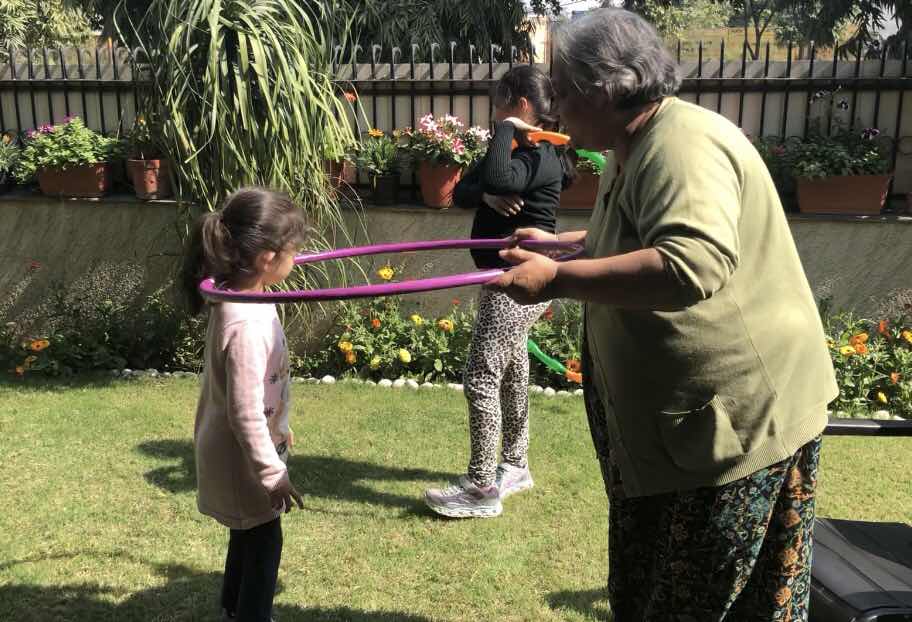
February is the best season here, and we spend a lot of time in the garden. One such day was February 24, 2019. We were in the garden and the children were playing with hoops. My younger daughter, Aria, wanted to learn how to hula hoop. But I had never played with it. Then, we discovered that Mom had been an avid hooper in her childhood! She was instantly roped into the hooping madness! 


She talked of hooping with different body parts, and demonstrated with her arm (the only one she could do without having to get up from the chair!) Much hilarity ensued as she tried to teach the technique to the children. 


A sunny February morning spent in fun and games. No, Aria did not get the technique of hooping down at that time. But, the next year brought the Covid 2020 lockdown. Stuck at home, she tried it again late summer. 

In August 2020, she turned 6, just as old as her Dida had been in the 1959 photograph. By October 2020, she had the technique down and was hooping away till she got tired! She even started hooping to songs. And all along, her Dida was there - to cheer her on, and watch her skill rekindle in her granddaughter.  


6 decades, two 6 year old girls and one hula hoop. 

Friday, 7 May 2021

πŸ‘­Sisters Day out

By Asmita Basu (Toto):

Here is my favourite story of MM (Moon Maashi aka Dr. Monisha Choudhury) for your collection. 

I can’t remember the year exactly, it would have been 2005 or 06, with Diwali a few days away. The Metro had just started. Ma and Baba were visiting me in Delhi. There was excitement in the air as I got ready for work in the morning. ‘Moon’ was taking Ma (Atreyi Basu) out for the day. Of the many delights planned (and related repeatedly… in great detail…), a Metro ride was the main attraction!! I rolled my eyes and said ‘have fun’ before I left. I returned to Netaji Nagar late in the evening to the news of the bomb blasts in Sarojini Nagar. I was greeted by two giggling and slightly hysterical sisters. So this is how their day went—

Before boarding the metro to Darya Gunj, Ma decided to take photos, as was her wont. MM posed obligingly. All this INSIDE the Metro station. I doubt if even Metro promos have such extensive and joyous clicks. Unfortunately, the Metro officials didn’t take this ‘security breach’ too kindly. Ma’s camera was confiscated and they were marched off to the Metro office. Unfazed by her captivity, MM had long chats with the security personnel and everyone else around. They discovered that the halwai that supplied samosas to Lady Hardinge, was also favored by the Metro personnel. Much praise was heaped on the halwai and a consensus reached on the superiority of his samosas. Before letting the geriatric threats go, said samosas were ordered. They were fed, gently rebuked and made to promise that they will never take photos inside Metro stations again. You’d think that the sisters had learnt their lesson. But no. 

After getting to Daryagunj and spending happy hours shopping and gorging, MM decided to buy firecrackers for Rupesh (who was still a notun jamai, and took Diwali very seriously). So they went back to the Metro station, with a bagful of crackers… or explosives as the Metro prefers to call them. They didn’t make it past the x-ray machine. They beat a hasty retreat before being declared bona fide security threats. It was a sheepish auto ride home. And just as they settled down, the news of the Sarojini Nagar blasts broke!!

Author notes:

- Lady Hardinge Medical College - LHMC - was where she worked for over 35 years till retirement in 2018

- The Sarojini Nagar blasts occurred on 29th October, 2005 (Wikipedia), 2 days before Diwali. 

- Rupesh and I shifted to Gurgaon from Mumbai in the summer of 2005, to be closer to my parents. That was our first Diwali together in the same city. 

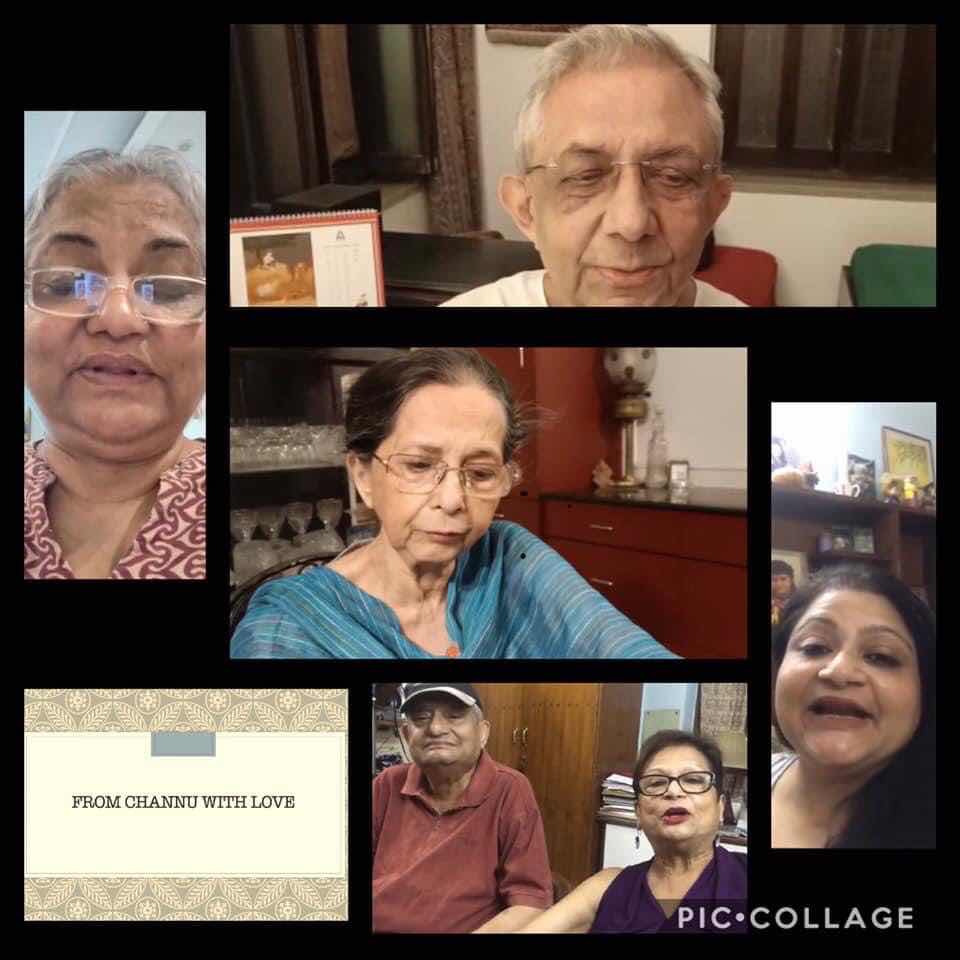
- Recent picture of the sisters, brother Biswajit Basu and family. Sep 22, 2020 video meeting in lockdown times. Pic Credit to Prajna Sen (Taddy Maashi) 


Monday, 3 May 2021

😞 REQUEIM FOR MY SISTER

By Biswajit Basu for Monisha Choudhury

Moon you have  relinquished your worldly status and left your friends, relatives, students and colleagues forlorn.  We, you left behind, will miss you sorely and we already realise how much.

Yours was a life of honest, steadfast and straight thinking, of keeping your focus on your objectives, of the grit of steadfast determination.  On the other side, you held the world in compassion in a profession where people tend to lose theirs.  I remember the time when you cried and cried when your patient who had been bitten by a rabid dog and who you had been desperately trying to save died.  I also remember how much you cried when you got your quota of vasectomies and tubectomies that you had to deliver to the government in those horrid Sanjay Gandhi days.  I always marvelled how you could be so prim and proper and headmistressly on one side and still retain a soft heart of pure gold on the other.

Yesterday marked the end of of our 68 year sojourn that we walked this Earth together.  I remember the day you were born and Daddy, Dadu, me and Mama had gone to visit Ma in the maternity ward.  Ma offered me a banana which was on her bedside table which I accepted and demolished it with a gusto which I  exclusively reserve for  eatables.  On the return in the car, Dadu castigated me for accepting that banana which he said was actually meant for you.  So even before you were born, I was stealing things that were yours!

And so we led our happy army childhood in big houses with big compounds and gardens which, incongruously Daddy described as 'genteel poverty'.  I remember you as a 3 year old in London with a big parakeet, as big as you, on your shoulder.  I remember we played catch me if you can in the garden and the catcher was supposed to be dirty (a guinea pig) and when caught he/she was 'guinea-ed'.  Remember our lovely vacations every summer to the hills? Then came the years of separation as we chose the trajectories to our respective careers. 

Then we saw Daddy go first after a five year ordeal with strokes.  Then came Ma's turn and she left after a short illness.  We were now suddenly orphans!

We passed our lives busy with the work in our respective professions. We got married, you to Panna and ne to Tulu.  Panna was a friend and today, a God, and I still ask him for guidance in troubled times.

Even when we were apart we always stayed in contact and sometimes met in distant cities (I remember that lunch in London when we got sozzled on wine and champagne and I prayed that you would reach your hostel back  safely)!

Today you are gone leaving us for a better world.  So be it. But I wish you would have stayed longer.  

So farewell, Moon, you will not be forgotten in this world.  You led a good and productive life.

 But all things, even our Universe, must come to an end  and  goes through different dimensions.  So have you departed our dimension forever to a better one. 

 *Au revoir*.


 That was the essence of our lives  We fought, played and cried together. 

Those were the days, dear Moon,

They have come to an end, but too soon

We'd laugh and play forever and a day

We led the lives we chose

We fought, but never to bruise

Those were the days

Yes, those were the days.

Farewell Moon.  We had a great life!


Jan 2021


πŸ™ Farewell Ma (Dr Monisha Choudhury)

When I first started this blog, I had no inkling Ma (Dr Monisha Choudhury) would leave us so soon. Her razor sharp recollection, memories of details and linking one situation to another, provided rich commentary to the blog posts here till now. It is impossible to believe she will no longer add her own additions to every story told. 

Rest in peace Ma πŸ™πŸ˜”

On Apr 21, 2021, she tested positive for covid. Starting with mild symptoms, she developed a persistent cough and weakness. Back in Dec 2014, she had fought swine flu with 3 weeks on ventilator and came back with a vengeance! Discharged in the second week of Jan, she immediately planned and executed her grandson Ashwin’s mukhe-bhaat by end of the month! Despite losing her beloved husband to cancer in Sep 2015, she persevered, becoming the President of the Indian Academy of Cytologists and presenting his rare case of cancer to an international audience in Yokohama, within months. With a history of resilience and fighting spirit, we all teetered on the edge of hope, despite her co-morbidities. 

She always said she wanted to work till her dying day, and her wish came true. Retiring from government service in Jan 2018, she immediately joined Sharda University the next month, till the Covid lockdown in 2020. 


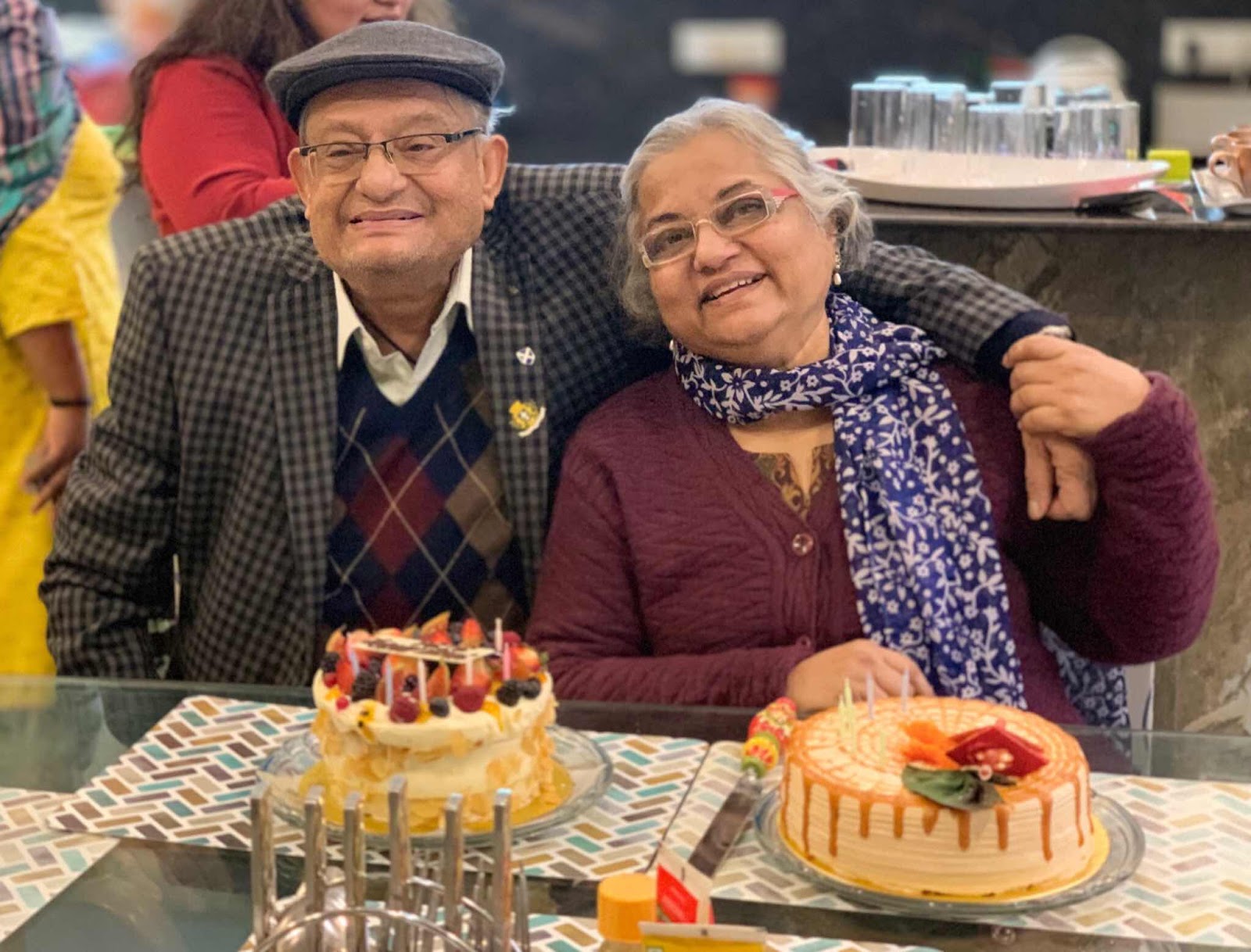
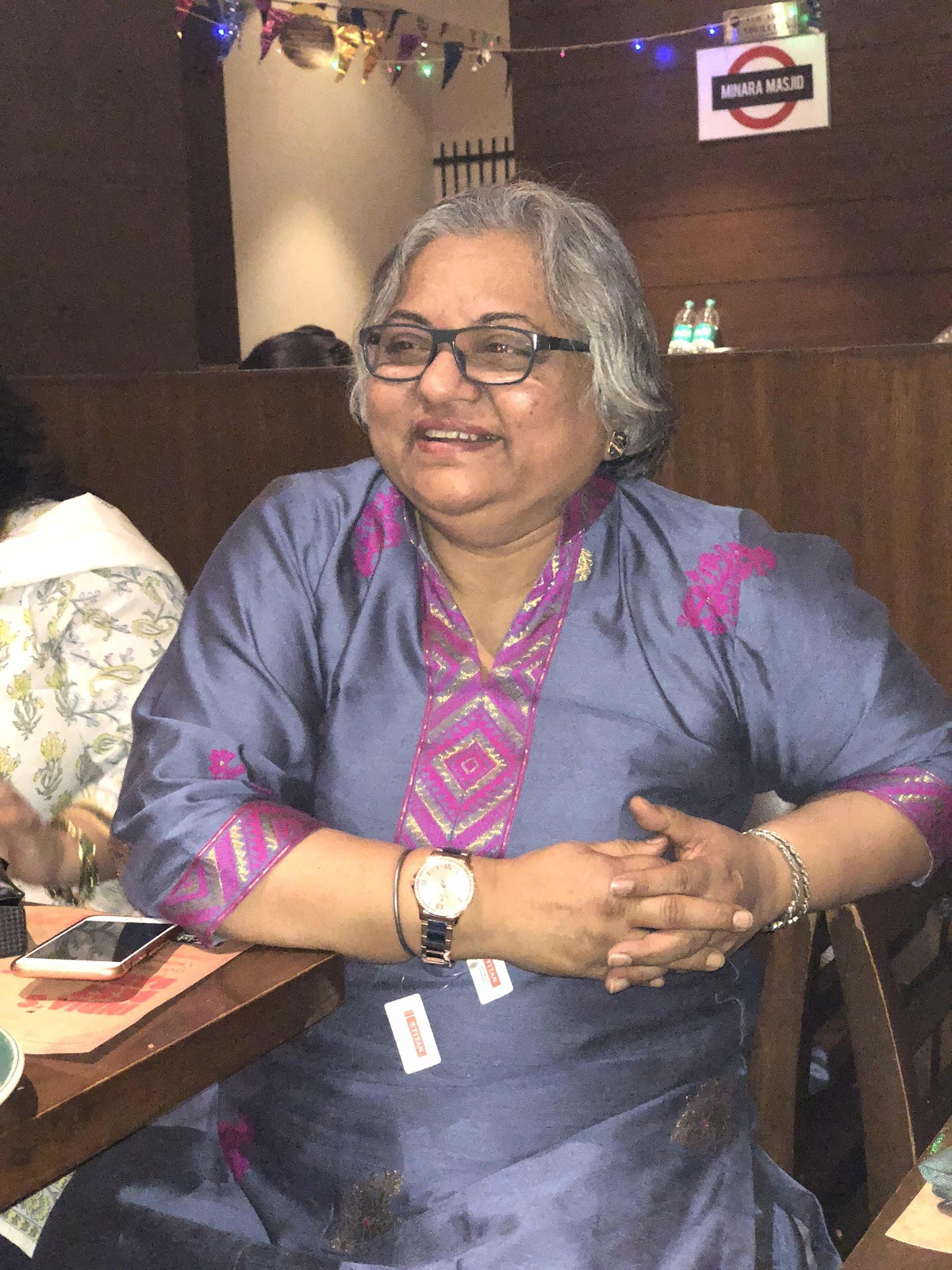
At her LHMC Farewell dinner at BBQ Nation, Noida on Feb 10, 2018, with her farewell gift watch. 


LHMC Farewell Department photograph

After an year of lockdown, she got her first vaccine shot and joined Noida Institute of Medical Sciences in March 2021. So happy to be back in the teaching chair, she was taking vivas and correcting answer sheets as an external examiner to LHMC even on the day she was hospitalised!


(Covid Vaccine first day first dose, Mar 01, 2021/ Covishield)


(NIMS, HOD Pathology, Mar 03 2021)

She tested positive for Covid on April 21, 2021; just as the deadly second wave hit India and collapsed the health infrastructure. Despite starting with mild symptoms, she developed a persistent cough. With co-morbidities of diabetes, hypertension and renal impairment; along with past history of ventilator in swine flu, we took no chances and got her admitted at the earliest availability at Yatharth Greater Noida on Sunday April 25th, evening 7-8pm. 

She was in covid ward but was shifted to HDU on Tuesday night due to declining O2. She suffered a collapse on Tuesday early morning 3:30 by O2 falling to 50s but was able to come back to 80s on bipap. From there she rose to maintain 90-92 on bipap but could not go off high flow pressure. 

On Sunday, May 02, 2021, she collapsed in cardiac arrest at 9:33am and could not be revived. 

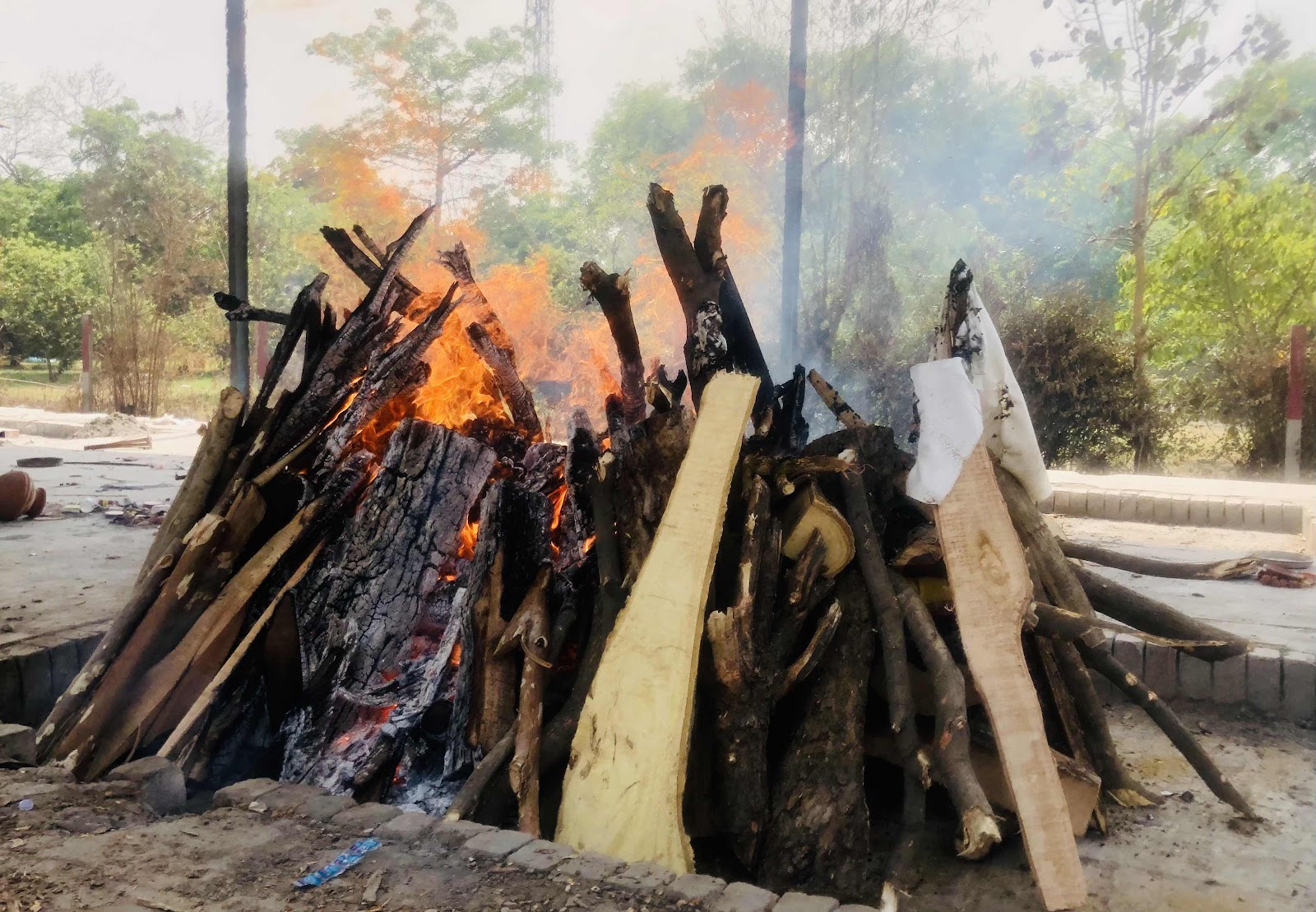
Within the covid weekend lockdown, her last rites were completed by me at Antim Niwas, Noida; at around 9-9:30am on May 03, 2021. 

Rupesh, my husband, was my rock and the main person doing all the real work assisted by our drivers Niranjan and Brijesh. Surabhi (my sister), her husband and son, flew in on May 02 evening to lend their shoulders. 

Throughout her hospitalisation, we had a network of many doctors who were her and Baba’s (Dr Panna Choudhury) friends and colleagues. They guided us throughout and used their own networks to help. A concerned network of family and other friends also kept regular track of her progress. (On that last fateful call from Dr Vinay at Yatharth HDU, we had Dr Ashok Dutta on line with us. He recently had seen his own son through the illness. One of Baba’s oldest friends, it was in his house that my paternal grandparents stayed when they came to discuss and fix my parents marriage in the 1970s! As recently as just before lockdown, he and Ma had also been colleagues at Sharda Hospital.)

Yet with all our combined efforts, we could not save her. She was scared and alone in the hospital and I tried to reassure her in every call. Her last call came on Saturday afternoon just when we had a major fire in the house. I stood in the neighbouring bank branch driveway and reassured her she was doing well. She was scared, upset that they hadn’t changed her clothes, and wanted to know when she would be discharged. I tried to reassure her, keep her fighting, give her hope. She ended the call on my last words ever to her, I love you. 

I’m so lost, this is the third time I’ve written and rewritten this post. So much happened in such a short time. I’m spinning like a planet without its sun, trying to take it one step at a time. Sleep eludes me. I miss you Ma πŸ˜”


(Times of India, Hindustan Times announcement on May 03, 2021)


(Last rites and cremation at Antim Niwas) πŸ™

She’s all yours again Baba. May you be our guiding lights, always. 


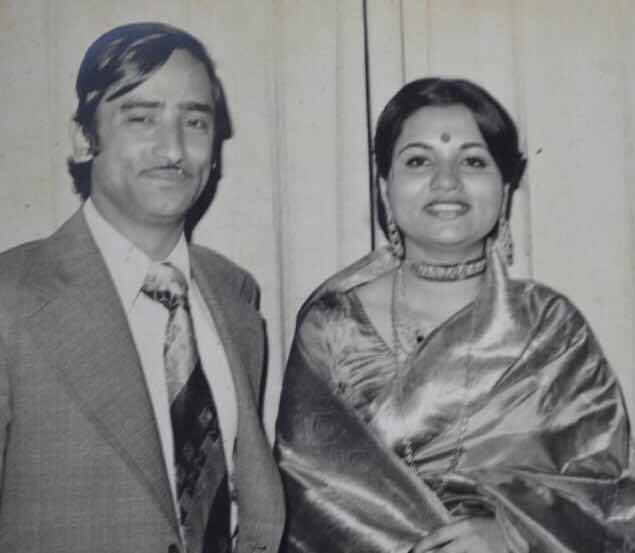
(Wedding of Dr Panna Choudhury and Dr Monisha Choudhury neΓ© Basu. March 06, 1978)

Wednesday, 31 March 2021

🌍 🌎 🌏 Three Canals World Voyage

By Biswajit Basu:

The *"Three Canal World Voyage"*

There was one voyage that I passed through three major canals of the world and went round the globe too. It was a memorable voyage I made on the Jalayamini. The year was probably 1973, my last voyage as a Second Engineer before my promotion to Chief Engineer. 
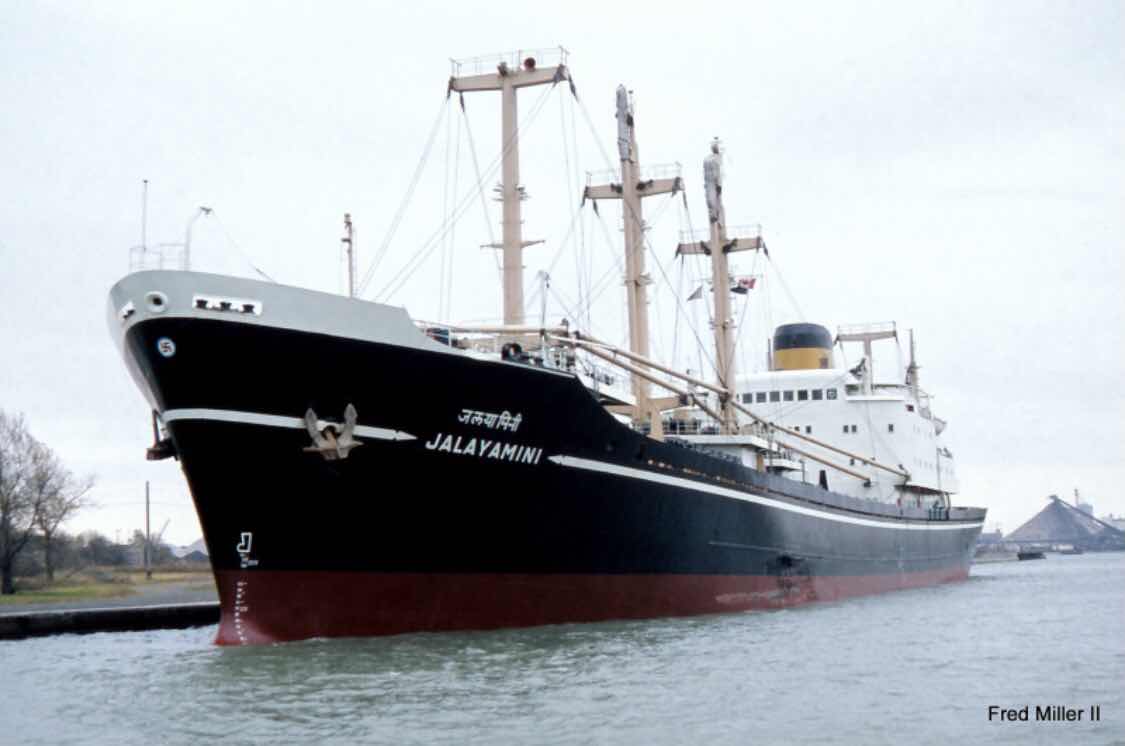

(From ShipSpotting.com)

My Chief was Sipahimalani, a tall, huge man whose  girth exceeded his height. He was the captain of the Scindia cricket team and brother of the Indian test captain GS Ramchand. He was also from the  filmy Sippy family who had shortened their name. All said and done, he was an insufferable character.

The voyage began quite normally and without fanfare from Bombay in the liner trade to Europe and back. I expected to be back in India within 4 months.  But that was not to be.


The first stop was at Port Suez at the southern end of the Suez Canal.  The passage through the Suez was quite uneventful except for the failure of the Suez Canal Light which was a monstrosity that was placed on board at Port Suez and meant to be used during darkness during the roughly 15 hour passage through the Suez Canal.  The switch of this monstrous lamp was a mercury switch which failed.  I refused to have anything to do with it and advised the captain not to pay for its rental.  Anyhow, we did manage to make it through without the use of this horrible looking lamp.

Then we were in the Mediterranean and sailed past Alexandria where the Collosus of Rhodes once stood guarding the entry into River Nile. After sailing the length of the Mediterranean, we entered the Straits of Gibralter.  The two ports guarding the entry to the straits was Gibraltar to the north on the Iberian peninsula and Ceuta of Spain to the south in Africa.  


We hugged the north coast as per the traffic  regulations and passed into the Bay of Biscay.  Through tumultuous seas we went past the English Channel to the lively port city  of Rotterdam.

Rotterdam was a lovely city with windmills, old houses and rivers all around.  I also took the opportunity to visit Amsterdam, 100 miles away (an hour's train ride) and admired this gothic city.  I could not go to the Rijksmuseum to see Rembrandt's *Night Watch* and sorely regretted it.
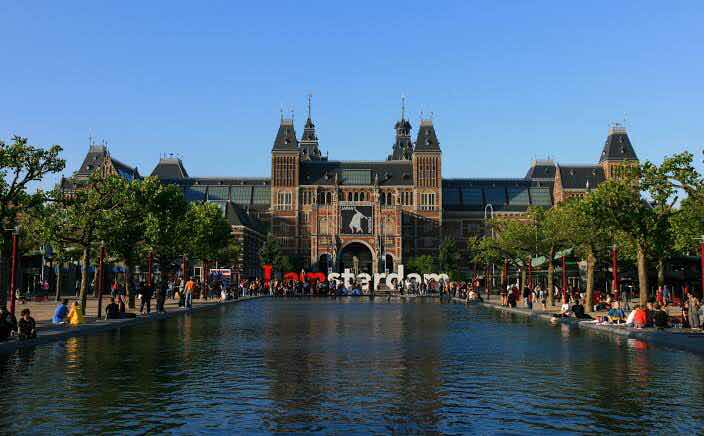

(Rijksmuseum)

Our next port was Hamburg (in W Germany those days) and for that we had to go through River Elbe.  Hamburg is a sailor's port.  Terrific night life, pubs, bars and restaurants galore.  Our next port was Gdansk (old Danzig) and the adjacent port of Gdynia in Poland. 


To reach Gdansk, we had to go through the Kiel Canal.  Nothing spectacular but something mysterious happened.  I was in the Engine Room when I got a call from the Captain on the bridge that the ship was suddenly listing to port (left of the ship) slightly.  I looked at the Clinometer and sure enough it showed a small list.

I assured the captain I had not transferred any oil or altered the water ballast configurations.   He sounded worried and requested me to transfer some oil to correct the list which I did.  But surprise of surprises, within half hour, the ship was suddenly listing to starboard (right) and I called the captain and he requested me to transfer the oil back, which I did and the ship righted and stayed so.

That evening, at the dinner table, the captain explained the mystery.  We were passing a nudist colony on the port side and the entire ship's staff had collected on that side to wave at the nudists thus listing the ship!

We then went to Gdansk and we had to anchor for a few days in the stormy Baltic Sea  before we got a berth. Though I had never been seasick throughout my sea career, the monotonous roll and pitch of the ship made me want to throw up; which I, fortunately did not.

But there we got the message that we have to now go to the East coast of USA instead of back to India. 

I will spare you the details of the Atlantic crossing but we did the usual round going to New York, Philadelphia, Charleston, Wilmington, Houston and New Orleans. 
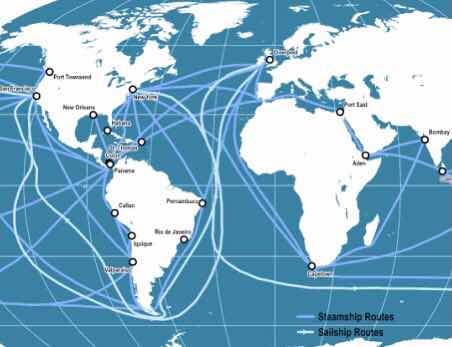


We were then told that there was no cargo available and we had to go to the West Coast of USA to pick up cargo.  This was my first encounter with recession in shipping which had turned our liner into a tramp.  This meant we would have to go through the Panama Canal.  We stopped at Veracruz in Mexico and anchored off Colon to await our turn.  But a bit about the Panama Canal first.
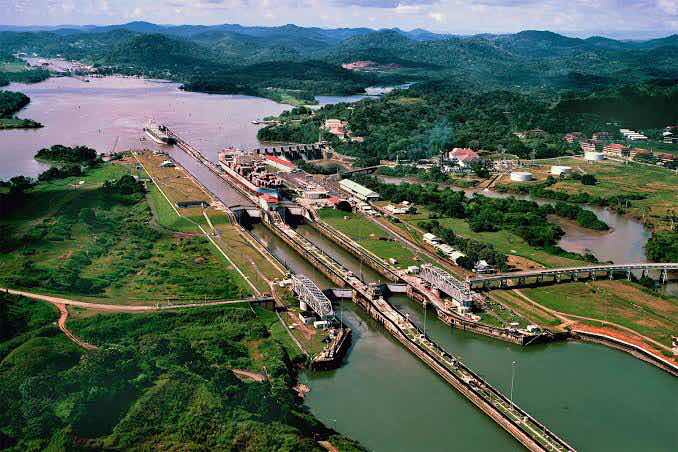

(Panama Canal, from Britannica)

The Panama Canal was not as easy to build as the Suez Canal.  The main difference was that whereas the Suez cut through a flat desert landscape,  the Panama Canal had to pass through hills and forests.  However, the French approached this problem like a pushy bull in 1881. After a couple of years they were defeated by the landscape and the anopheles mosquito (malarial) and they abandoned the project. Their scheme was untenable financially as well because it entailed making a channel through the hills that meant removing thousands of millions of cubic metres of earth to get a straight channel through like the Suez from the Atlantic to the Pacific. Also the Pacific Ocean  was higher than the Atlantic Ocean off both the coasts of Panama. That meant that the sea would create tidal waves within the channel which is quite unacceptable.

The project therefore was taken up by the Americans.  They came up with a feasible engineering plan and the finances to back their project. Where there were hills, the American plan was to have locks which would raise the complete ship up the hill on one side and down on the other side. There are twelve such ship locks most of them being northeast of Panama City on the Pacific Coast.  The ship's would be pulled through by locomotive engines at these locks.  In echoes that would also reverberate 33 years later in India, the Panama Canal was inaugurated on 15 August 1914.

(Author note: The Panama Canal was expanded in 2007-2016)


(Panama Canal Schematics, Wikipedia)

So back to the Jalayamini. At one stage we were passing the locks at night and I went up from the Engine room to the deck to take advantage of the stopped engines while we were being hauled up by locomotives. In the darkness of the dim lights I saw a  team of men hauling and transferring our ship's ropes.  I saw that one of them was wearing a hat which I took to be a somberero. But when he was closer to me I thought it looked more like a turban.  I took a chance and shouted "Ki gal hai, paaji".

"Changa" came the reply. I was stunned. Here we were  half way across the earth and I was conversing with a Sardarji in the middle of the night in the wilderness in a distant land! Anyway, we moved on and this man disappeared into the darkness.

On the west coast, we went to Long Beach, San Francisco, Portland, Seattle, Vancouver and Port Alberni.  It was then across the Pacific which became a bit of a nightmare.


(Author Note: The Pacific Ocean is immense. In flat maps, it’s relegated to the outer edges, and that’s the image most of us hold in our minds. But in reality, it spans an entire side of the globe!)

Almost everyday, the ship would start going round in circles in the middle of the Pacific. Sipahimalani and I tried our best to resolve the problem but nothing worked. Our next port was Manila and the guys from Siemens (who provided the controls for the rudder) came over and did something and everything seemed ok.  But again a day after leaving and on our way to Hong Kong it  happened again. This time I decided to go to our Radio Officer, as he was the only guy who knew about Electronics (it was early seventies, remember). But again there was no solution. At one moment, I saw a book by Taraporewala and while leafing through it I came across a picture of an electronic card with a hammer shown next to it.  I went to bed and thought about it and decided to try one more time next morning.

I had told the Mate who was the Officer on Watch that I would be fiddling with the steering gear.

I tried a lot of things but nothing seemed to work.  We sailed on with the steering on emergency. Suddenly the vision of the page with the printed card and a hammer came back and I took each card out of its socket, tapped it (gingerly) on the bulkhead and put it back. It seemed to work. Although we took tug assistance to enter Hong Kong (just to be safe) the steering worked fine. Thereafter, we went on to Singapore and then to Bombay and there was no hint of trouble. Sipahimalani asked me many times what I did and I replied "Nothing". I had not learnt to like him enough to tell him what had solved the problem.

In Bombay, the round the world trip was over and I went to meet Mr. Sathe, our director.  He said, Sipahimalani tells me, “you were in the steering flat and you did something that solved the problem on which we have already wasted thousands of dollars.  Don't tell me you did nothing".  So I sheepishly told him that I had done nothing more than tapping each card on the bulkhead. He smiled and nodded. He told me to go on a few days leave to Delhi.

A few days later I got a telegram to join the Jaladhruv as Chief Engineer.  *I had got promoted!*

(From ShipSpotting.com)

Postscript by Monisha Choudhury:

I think Dada had written letters to me about this trip. I have vague recollections that in 1975 all my friends were going to give USMLE either in Lahore by train via Attari or Colombo or Manila, and Dada promised to fund my trip, if I cleared, to New York, USA at a princely sum of Rs 4000/-. But that was not to be as Daddy had heart failure with pulmonary oedema in 1975 followed by Ma with a subendocardial infarction during my Internship in 1976 and I completely gave up the idea of going abroad for further studies as Dada was still at sea.

Author Note: Life may have had other plans, but she would go on to pave her own way to realising her dreams. 16 years later, in 1992, she went to London to pursue an 18-month fellowship at St.Mary’s Hospital. The US dream became a reality as well, with subsequent stints in Chicago and Boston (Brighams Women Hospital, Harvard Medical College). 

Subsequently, he (Biswajit Basu) left Scindias and joined SCI and got married. It was around that time in Summer when we had a huge theft in our house where Boudi (Swati Basu) lost a lot of her marriage jewellery and we managed to catch one guy. Daddy made it his lifetime mission after that to bring the culprits to book and even met the then Prime Minister Morarji Desai! Not much effect though as the guy many years later was caught for some other theft!

Monday, 29 March 2021

🌍 Stories from the Suez

Ever Given, one of the longest container ships in the world today, ran aground on the Suez Canal on March 23, 2021. One of the busiest shipping routes ended up in a disastrous traffic jam, as the world reverberated with the consequences and were glued to the efforts to free it. 


(When your predicament is visible from space, you know you have a big problem! Read more about this event here.)

As we followed the news, Biswajit Basu’s experience in sailing through those waters, gave us all a deeper connect with the Suez. Let’s travel back in time with him, and visit the Suez of bygone times. Despite the passage of many decades, it feels like some things - like busy ships lining up in a narrow canal and battling the treacherous North Africa winds - stay the same!

By Biswajit Basu:

*SUEZ CANAL, 1955*

My first passage was through a Canal was the Suez Canal in July 1955 on the Polish Ocean Lines Motor Ship Batory. After Karachi and Aden, we went through the Red Sea. I remember my favourite pastime was to lean out of our cabin porthole and try to make one end of a strand of wool touch the sea. As far as I can remember, I never succeeded as the wind would blow my strand of wool horizontal!

[Author note: That poor strand stood NO chance! 66 years later, we are watching the 220,940 GT Ever Given, longer at 400m than the roof height of the Empire State Building, get blown horizontal across the canal!]

Anyway, then we reached Port Suez at the entrance to the Suez  Canal. We picked up our pilots and proceeded up-canal to Port Said at the northern end of the Canal. Port Said was our next stop with some waiting time at the Great Bitter Lake in between.

The Suez was historic. The canal was built for the Ottoman Turks (the Mamluk Dynasty had conquered Egypt) by French Engineers (de Lesseps). But, with the weakening of the Ottomans, the British bought their shares and became owners of the canal.  However, when Nasser came to power, he nationalised the canal and the British and Israelis mounted a combined attack on Egypt. The British-Israeli combination won. However, this fight was still going on when we had to return from England in 1957.  Since the Suez Canal had been closed down, we had to return to India via the Cape of Good Hope at the sothern tip of Africa retracing the path of Vasco da Gama 450 years before (Vasco reached Calicut on 19 May 1498). We returned on Steam Ship Circassia of the Anchor Line.  This was a much more luxurious ship and must have cost Daddy a bomb because we had to also take the longer route round Africa.

[Author Note: You can read more about these ships in our earlier blog posts - My First Sea Voyage and The First Voyage Back Home

Back to the young boy and his wool thread blown by recalcitrant winds...]

At Suez, the ship was invaded by hordes of traders who exhibited their wares on deck. They were wily and cunning and we were asked to beware and keep our cabins locked.

These traders (known as Gyppos, as they could rob you blind) brought all kinds of stuff.  Right from trinkets, carpets, antiques (usually dishonestly peddled as pharonic stuff), leatherware (usually camel) etc. etc. etc.  The decks were full of these little stalls put up by the Gyppos. (They were ubiquitous and came on board regularly also when I was sailing professionally on Scindia ships in the seventies).  I think they will be there even today!

After the Great Bitter Lake, we entered the northern stretch of the Canal.  In front of us was gleaming white beauty: the Steamship Himalaya of the Peninsular & Orient Lines. 


(SS Himalaya, pic from Wikipedia)

The Himalaya was a fabled ship, 'the Greyhound of the Seas' is what she was called and was top class in luxury and speed (with fares to match, I am sure).  She had left Bombay two days after us, had caught up with us at Suez and was destined to reach England 2-3 days before us.  She did the India-UK run in 14 days as conpared to the Batory which did it in about 20 days!  She was white and beautiful and led us like a queen!

I remember Port Said distinctly.  Even more Gyppos boarded but Daddy had decided we had enough of sailing and took us to town for an outing.  Port Said was a dirty town and I remember the ubiquitous flies. They were everywhere and could buzz you to death! 


(Port Said leaflet, Orient Line, 1955; from Museums Victoria Collection)

I remember Ma bought two beanbag-like camel leather stools. They were with us for many years but I do not know where they went. Maybe we lost them in our shift to Delhi from Bangalore.

So, that was my first passage through the Canal (though I would go through again in the seventies). We would still have to sail through the stormy Bay of Biscay and Southampton was still a week away.

In fact, it was in 1976 in Port Said, on my way back to India from the Great Lakes, that I received the letter which informed me of Ma's heart attack and Daddy's accident and I decided to quit going abroad. (More about that trip is in this blog post Voyage of Misery)

The Suez Canal thus proved historic to me personally as well!


Postscript by Monisha Choudhury:

Ma also bought a tapestry of a lady in white gown  with a matka of water and camels, which we had on our drawing room walls in R3 (Hauz Khas) till it was faded and falling apart. Even the two light brown and green bean bag with camels and Nefertiti on them were finally discarded in R3. They must have been bought at Aden or Port Said).

Sudeshna Dey memories

  Picture of Sudeshna Dey and her grandmother Gopa Ghose, circa unknown.  Gopa Ghose - age 30s, Darjeeling Sudeshna Dey nee Ghose - 21 years...